3363. Find the Maximum Number of Fruits Collected
Intuition
- We can intuitively know that this is a dp problem as it is very similar to this problem
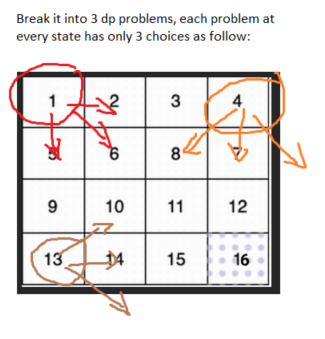
- Now that we know it, we can try breaking the 3 childs into 3 seperate dp problems and solve each one, then we can get the sum as the final result
- There is one problem though, as the problem stated that the fruits of every position can only be taken once, so after calculating each child, we have to mark the optimal path of that child to 0 to avoid over counting.
- As there are only
n-1moves and we HAVE TO arrive at position (n-1,n-1) for the result to be valid we can: - Rebuild the optimal path using the memoize table
- For the first child at position (0,0), there is only 1 valid path going diagonal, so we can simply do a for loop to calculate and mark it as 0.
Approach
- We break down the problem into 3 smaller dp problems:
top_left,top_right,bottom_left, do the dp calculation for each one - For the
top_left, we can just calculate the diagonal path from this position and set each cells to 0 because this is the only path - For the next child, after calculate the optimal result, we can rebuild the optimal path and set its cells to zero with
cleanup - The 3rd child we can just do dp calculation and return the sum, no need to mark its path.
- For the dp recursive function:
- At each state, we have 3 choices (3 way to move)
- The states variables are the
xandycoordinates, I usedrandcwhich is short for row and column. - The base cases are:
- Position out of bound, check with
valid() - Out of moves but still have not arrived at the destination
if(moves == 0 && !(r == n-1 && c == n-1)) return INT_MIN; - When we arrive at the destination
if(r == n-1 && c == n-1) return 0; - When we have already calculated this path
if(dp[r][c] != -1) { return dp[r][c]; }
- Position out of bound, check with
- The recursive formula is pretty simple, we just try to get max fruits from three choices
dp[r][c] = max({3 choices here})
Complexity
- Time complexity: O(n²) size of the board
- Space complexity: O(n²) for the memoize
dptable
Code
class Solution {
public:
    vector<vector<int>> dp;
    int n;
    bool valid(int r, int c) {
        return min(r, c) >= 0 && max(r, c) < n;
    }
    int dfs_topr(vector<vector<int>>& fruits, int r, int c, int moves) {
        if(!valid(r, c)) return 0;
        if(moves == 0 && !(r == n-1 && c == n-1)) return INT_MIN;
        if(r == n-1 && c == n-1) return 0;
        if(dp[r][c] != -1) {
            return dp[r][c];
        }
        int left = fruits[r][c] + dfs_topr(fruits, r+1, c-1, moves-1);
        int down = fruits[r][c] + dfs_topr(fruits, r+1, c, moves-1);
        int right = fruits[r][c] + dfs_topr(fruits, r+1, c+1, moves-1);
        dp[r][c] = max({left, down, right});
        return dp[r][c];
    }
    int dfs_botl(vector<vector<int>>& fruits, int r, int c, int moves) {
        if(!valid(r, c)) return 0;
        if(moves == 0 && !(r == n-1 && c == n-1)) return INT_MIN;
        if(r == n-1 && c == n-1) return 0;
        if(dp[r][c] != -1) return dp[r][c];
        int up = fruits[r][c] + dfs_botl(fruits, r-1, c+1, moves - 1);
        int right = fruits[r][c] + dfs_botl(fruits, r, c+1, moves - 1);
        int down = fruits[r][c] + dfs_botl(fruits, r+1, c+1, moves - 1);
        dp[r][c] = max({up, right, down});
        return dp[r][c];
    }

    void cleanup(vector<vector<int>>& fruits) {
        int r = 0, c = n-1;
        while(valid(r, c)) {
            int f = fruits[r][c];
            fruits[r][c] = 0;
            r++;
            if(valid(r,c-1) && dp[r][c-1] == f + fruits[r][c-1]) {
                c--;
                continue;
            }
            if(valid(r,c) && dp[r][c] == f + fruits[r][c]) {
                continue;
            }
            if(valid(r, c+1) && dp[r][c+1] == f + fruits[r][c+1]) {
                c++;
                continue;
            }
            break;
        }
    }
    int maxCollectedFruits(vector<vector<int>>& fruits) {
        int res = 0;
        n = fruits.size();
        for(int i = 0; i < n; i++) {
            res += fruits[i][i];
            fruits[i][i] = 0;
        }
        dp.assign(n+1, vector<int>(n+1, -1));
        res += dfs_topr(fruits, 0, n-1, n-1);
        cleanup(fruits);
        dp.assign(n+1, vector<int>(n+1, -1));
        res += dfs_botl(fruits, n-1, 0, n-1);
        return res;
    }
};